FAQs
Plug In Solar is now legal (from 27th August 2026).
From that date, a fully ENA compliant plug-in Solar kit (solar only, no Battery Storage), may legally be connected via a standard 5A socket in England, Wales and Scotland.
These new regulations will allow up to 2,000W (2kW) of Solar PV power, connected to a Micro-Inverter with a maximum output of 800W.
Connecting Solar Panels with a larger rating than the Micro-Inverter is common practice in the UK and is known as the DC:AC Ratio.
You can see more information on our Plug In Solar Kits here: Plug In Solar Kits. All the kits we sell are fully ENA Compliant and listed on the ENA Register.
Plug-In Solar is a Do It Yourself (DIY) solar power system, which allows you to generate your own free electricity that you can use to power your appliances.Our kits are ‘out-of-the-box’ DIY Solar Kits, which include everything you need for your installation.
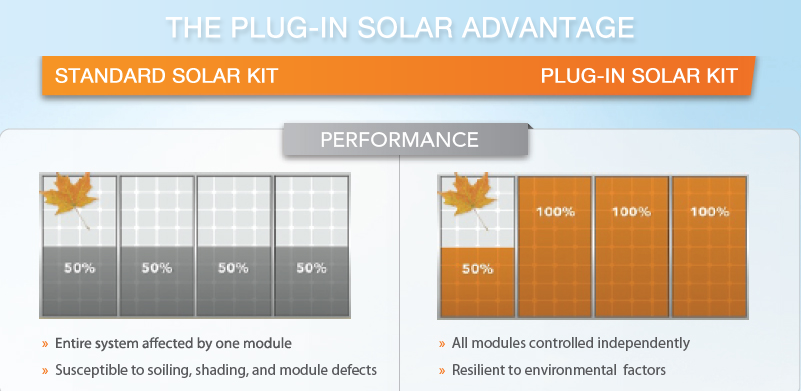
Plug In Solar Kits offer a simple plug and play installation (all AC Cabling), and enable each solar panel to operate to its maximum potential by reducing the impact of shading.
Plug-In Solar kits include all you need to start saving money on your electricity bills.
Our Plug In Solar Kits allow you to have a small Solar system (1-2 Panels), that you can simply plug into a plug socket. No need for an electrician or installer. Usually these kits are installed on the Ground or Wall.
Our DIY Solar Kits are larger Solar Kits (up to around 20 panels), and can be installed in a wide variety of locations (On Roof, In Roof, Ground Mount, Flat Roof, Tiled Roof, Corrugated Roof etc).
These kits have been designed so the majority of the installation can be undertaken by a competent DIYer/on site trades.
However under the UK’s current IET wiring regulations the final connection to the grid must be made, and signed off, by a qualified electrician who must create a dedicated circuit for the Solar Kit in your existing consumer unit/new sub board with the appropriate protections.
 Low Cost – Small InvestmentNo Labour Costs – Do it YourselfSimple DIY AssemblyNo EPC Inspections NecessaryNo MCS Certification RequiredPlug-In Solar can be expanded at any timeChoose your own location for your Plug-In Solar installation
**Surge protection is embedded into the Enphase Micro-Inverters, but you must ensure that any additional surge protection is provided (if necessary) to meet the IET Wiring Regulations.
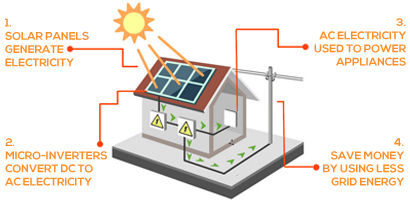
The electricity generated by the solar panels is fed (via the Micro-Inverters) directly into your mains electrical grid on the load side of the meter. The Micro-Inverters slightly exceed the national grid voltage in order to push the current to your mains grid. When there is solar energy being produced, the national grid recognises that no power is required, until the voltage from the Inverters drop again, at which point the National Grid provides the power.
This means the appliances will always use the energy generated by the solar panels first, before going to the National Grid. If you are using more energy than you are generating, the solar kit will provide as much energy as it can and the remainder will be supplied by the grid. In the event you are generating more energy than you are using, this excess energy will be sent back to the National Grid. This is completely normal, and legal. The two energy sources work in harmony, without any manual switching required. By reducing your electricity use in this manner, you save money on your energy bills.
There are 3 key areas to consider when choosing the correct size Plug-In Solar Power kit.
- How much electricity do you / will you use?
- How big is the area where the panels will be installed?
- Your budget?
How much electricity do you / will you use?
The most reliable point of reference for a retrofit solar kit will be the existing electricity bills for a property. Each home has a ‘base load’, which is the amount of energy used in an average day/week/month to power all the appliances in the property. You can work this out for your property by looking at your own electricity bills, or keeping records using your electricity meter.
According to OFGEM, an average household with medium energy consumption uses around 2,700 kWh per annum: More information here: Ofgem Average Electricity Usage
Dividing by 12 (for months of the year), the result is an average 225kWh per month.
This would mean that 6 x 500W Solar Panels, making up a 3.00kW (3000W) Solar Kit, would be required to cover 100% of the total electricity costs for the average household.
A 3.00kW (3000W) Solar Kit is estimated to generate 2,763kWh per year.
Please note, these are independent National Renewable Energy Laboratory estimates based on 30 years of previous weather patterns in a London, UK location. They are intended to give an indication of the performance you might see from your Solar PV Kit. They are not a guarantee of performance, and do not constitute financial advice. They assume you would use 100% of the energy you generate.
How big is the area where the solar panels will be installed?
Plug-In Solar kits can be installed on Tile/Slate On Roof or Tile/Slate In Roof, Metal/Wooden Roofs, Flat Roofs, or Ground Mounts. The number of panels you can install may be limited by this available area, but please ask us for help with designing your system, so we can help you achieve the biggest possible system for your needs.
What size solar power kit will fit the available budget?
Your budget will ultimately dictate the size of the solar panel kit that can be purchased. A lower budget will require a compromise on the number of panels you can install. This means that the percentage of the energy costs covered by the panels will also be lower, but you will still make savings.
As Plug-In Solar kits are modular in nature, it is possible to buy the kits incrementally, starting off small and building up a to bigger kit. This also helps spread the cost across a few months/years. However, if the budget is higher and space allows, it is worth considering increasing the number of solar panels. This will maximise the levels of energy that the solar panels will generate for the property, resulting in bigger savings.
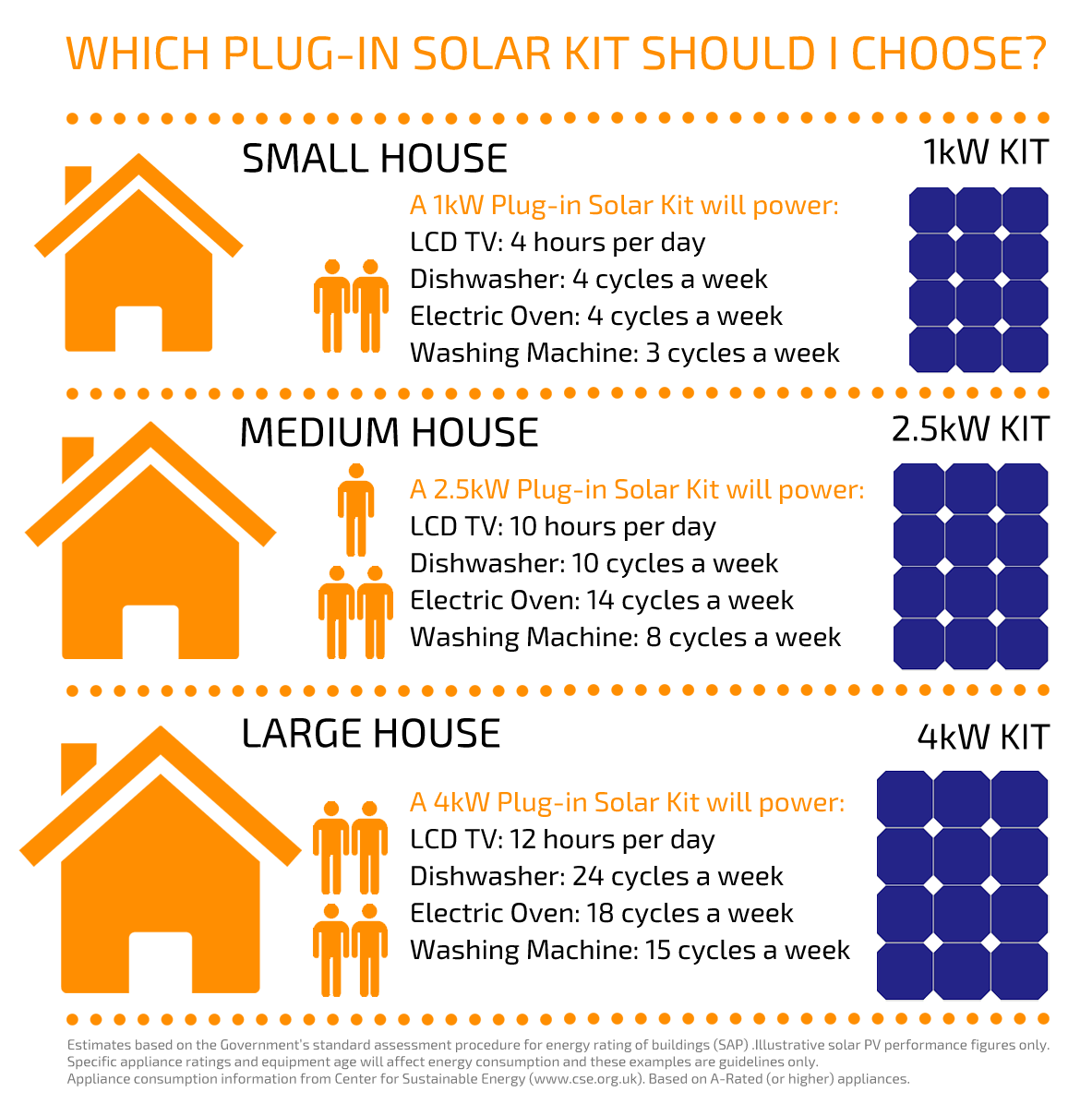
The bigger the kit, the bigger the energy saving. As an example, on average, a 1kW (1000W) Plug-In Solar Kit (which consists of 2 x 500W panels) will produce enough energy, in one year, to power***
| Washing Machine | Dishwasher | LED TV | Electric Oven |
| 1 cycle per week (52 times per year) |
1 cycle per week (52 times per year) |
3 hours per day (for 365 days per year) |
2 cycles per week (104 times per year) |
We also sell energy saving devices to help you use your power more wisely, such as Immersion Diverters or Battery Storage Please ask for more information.
You can apply for the Smart Export Tariff (SEG) with Octopus, even if you have self installed one of our kits, and you can apply for this Tariff here: Octopus SEG Tariff Application
The Feed-In-Tariff was a government based scheme that applied to solar installations that were undertaken by MCS accredited installers. The Feed-In Tariff ended on 31st March 2019.The current Smart Export Tariff (SEG) pays around 15p per kWh of exported energy. The components that make up the Plug-In Solar Kit have the relevant MCS accreditations and G98/99 Certifications to be suitable for an installation for the Smart Export Tariff.You can apply for the Smart Export Tariff (SEG) with Octopus here: Octopus SEG Tariff Application
Yes. Once you have installed, inspected and tested your Plug-In Solar kit, it is a requirement that you complete and return a G98 Engineering Recommendation Form to your Distribution Network Operator (DNO) within 28 days. You can find your DNO by entering your postcode using this website: https://www.ssen.co.uk/about-ssen/who-is-my-distributor/
**Calculations undertaken using the government’s SAP calculator which are based on industry averages and are used for guideline purposes only.
***Appliance age and energy rating will affect energy consumption. These figures are based on estimates and are for guideline purposes only. Estimates are based on A rated appliances or higher. Appliance consumption information from Center for Sustainable Energy (www.cse.org.uk)